
Meta-analysis on Social Media Privacy published In the Journal of Computer-Mediated Communication [25.02.26]
A new study was recently published. In a meta-analysis, Jana Dombrowski and Sabine Trepte examine and compare key factors that affect the privacy decisions of social media users.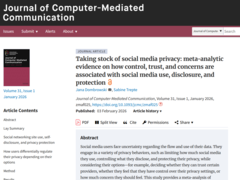
Source: JCMC
In a meta-analysis, they examine and compare factors that influence the privacy behavior of social media users. The aim of the study is to compile lessons learned from the extremely productive last decade of research on privacy. To this end, the results of 79 studies with more than 50,000 participants were summarized:
The results show that perceived control is the most important and consistent factor for protective behavior. When users have the ability to control their data, they protect their information while still actively participating on social media. Regulation and platform design should ensure that such control options are available, while literacy efforts can support users to exercise this control effectively when necessary.
Trust is not directly related to protective behavior, but it does enable engagement on social media networks. Trust is desirable: it helps users avoid feeling constantly alarmed. Regulation must ensure that actors actually earn this trust and do not just market it, while literacy efforts must teach users to recognize when trust should be questioned.
Privacy concerns motivate users to take protective action but are less strongly linked to the decision to engage on social media or disclose information. Overall, concerns are functional: they keep users alert to potential threats and promote privacy-conscious behavior.
Overall, research on privacy has indeed come a long way. Users are aware of their options and know how to protect themselves adequately against privacy violations. Now is the time to allow for positive perspectives and ask: How can privacy be a resource—something that users can enjoy instead of constantly having to defend against attacks?
The article has now been published in the Journal of Computer-Mediated Communication: www.doi.org/10.1093/jcmc/zmaf025
