ICA 2026 in Cape Town – Best student paper award and four presentations [19.05.26]
Under the theme “Communication and Inequalities in Context,” this year’s annual conference of the International Communication Association invited scholars across the world to Cape Town from June 4 to 8, 2026.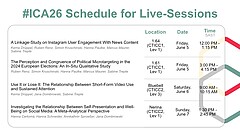
A team of students from Hohenheim University has achieved particular success with a study on self-presentation on social media. The project team, consisting of Hanna Certomà, Hanna Schneider, and Annkathrin Sproeßer, was recognized as one of the three best student contributions. As a result, the team will have the opportunity to present its findings on Sunday, June 7, at the prestigious Top Student Paper Panel of the Communication & Technology Division. The project was developed as part of the Master’s project seminar and was supervised by Jana Dombrowski and Prof. Sabine Trepte. In a meta-analysis of a total of 65 studies, the students demonstrated that authentic self-presentation on social media, in particular, offers an opportunity, whereas idealized self-presentation tends to pose a risk to users’ well-being. A preprint is available [here]
On Friday, June 5, the Media Psychology Department will present two studies from the current project on political microtargeting funded by the German Research Foundation (DFG). The project team consisting of Ruben Renz, Simon Kruschinski, Hanna Paulke, Marcus Maurer, and Sabine Trepte conducted a qualitative think-aloud study. Users were exposed to political advertisements within their personalized feeds. The results show that the targeted nature of advertisements is of secondary importance to users. When engaging with political advertisements, what matters most is the content and the positions presented therein. Dr. Simon Kruschinski will present this work.
The project also includes a large-scale quantitative study in which digital tracking technologies have now made it possible to get a comprehensive look at how users actually interact with content. Kerria Drüppel will present initial findings on how news consumption works in algorithmically curated information environments. The results show that interactions with news content are surprisingly rare overall. However, as soon as people interact with news, for example, through likes, comments, or shares, the likelihood that users will be shown more similar content in the future increases.
Without a doubt, attention has become a highly contested resource on social media. Consequently, there is concern that the constant availability of short, easily digestible content makes it difficult for people to focus their attention in a focused manner. On Saturday, June 6, Kerria Drüppel will present the results of a study on the link between attention deficits and the use of short-form video platforms(co-authors are Jana Dombrowski and Sabine Trepte). The results indeed show that people who watch short videos for longer periods have greater difficulty staying attentive. A preprint on this study is available [here]
We look forward to an exciting conference and the opportunity to exchange ideas in Cape Town!
